If you’re about to launch your first business, or if you’ve been operating for a while and are thinking about "finally getting the website right," you’ve likely faced this decision: do I use a template from Wix, Squarespace, or Shopify, or do I pay for something built specifically for my business?
There is no single answer—it depends on the stage your business is at. Here’s how to think about it.
When a template IS right for you
Templates exist because they solve a real problem: they allow you to establish an online presence today, without waiting weeks or spending thousands of dollars. It makes sense to use them when:
You are just starting out and are still testing your business idea.
You don't know if it's going to work, so it makes no sense to invest heavily in technology before knowing if there are customers.
Your business is simple:
A menu, a list of services, contact information, a couple of photos. You don't need anything that a template can't handle.
Your budget is limited.
You need to prioritize other things (inventory, rent, permits) over the website.
You do not plan to develop special functionality.
You don't need online scheduling with complex logic, order tracking, or anything beyond "providing information and getting contacted."
If any of these situations apply to you, a template is the smart choice—not the cheap one. Use it without guilt.
When your business has outgrown a template
The problem isn't that templates are bad — it's that they weren't designed for your specific business, but rather for thousands of generic businesses at once. You start to see the seams when:
You need the page to *do* something, not just look good.
For example: a customer being able to see their order's location in real time, a price being automatically calculated based on distance or quantity, or a form connecting directly to your internal system.
Your clients are asking you for something that the template doesn't offer.
The platform's technical support tells you "that's not possible," or that it can only be done with an unreliable third-party plugin.
You pay monthly for several separate tools.
The theme, an appointment plugin, an inventory plugin, a payment plugin—that don't communicate well with each other—and you end up being the one fixing the errors by hand.
Your brand looks "generic."
Because, let’s be honest, anyone using the same template as you ends up looking similar. When your distinctiveness starts to matter more, generic design detracts rather than adds value.
Speed and SEO are holding you back.
Las plantillas cargan mucho código que no usas (porque sirve para todo tipo de negocio), lo cual afecta que Google te posicione bien y que el cliente no se aburra esperando que cargue.
When you recognize two or three of these signs, it is no longer a matter of "I’d like" to have something custom-made.
The thing is, the template is costing you sales without you even realizing it.
La comparación de costos, sin adornos.
This is where a lot of people get confused, so let's get straight to the point:
- Template:You pay a low monthly fee (usually between $15 and $40 USD/month), but that cost never ends, and it rises as you add plugins or more features. After 3 or 4 years, you’ve often paid more than a custom solution would have cost—and you still don’t own anything; you remain dependent on the platform.
- Custom page:There is a higher initial cost (because it is built specifically for you), but the subsequent maintenance cost is much lower; you own the code and can keep adding features without depending on whether the platform "allows it" or not.
It's not that one is "expensive" and the other "cheap."
These are two different payment models, and it is best to choose based on how long you plan to use the solution.
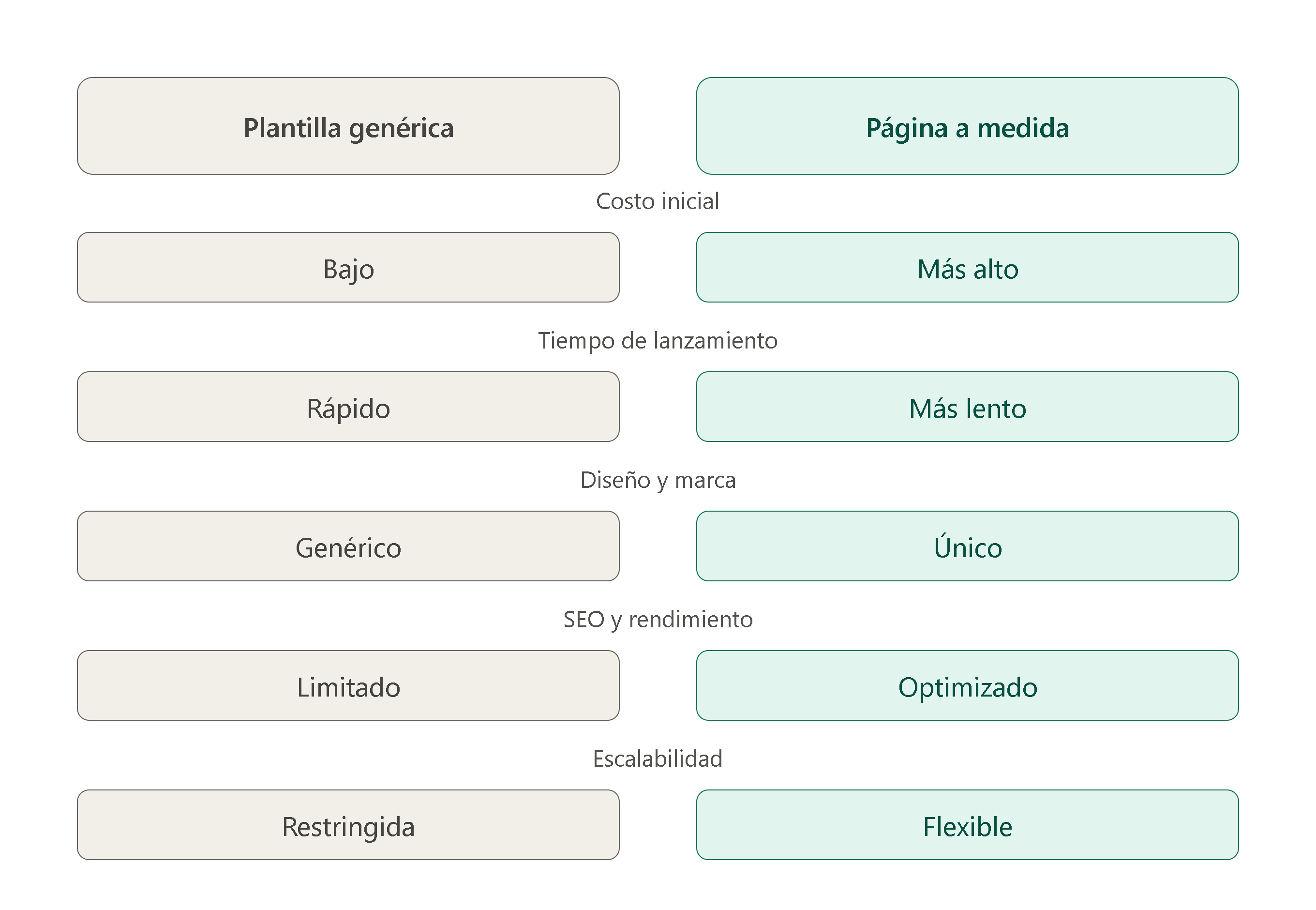
In short: a generic template wins on cost and speed to market, whereas a custom site excels in unique design, SEO/performance, and long-term scalability. The decision depends on whether the client needs to launch quickly and affordably or build a solid foundation that grows with the business.